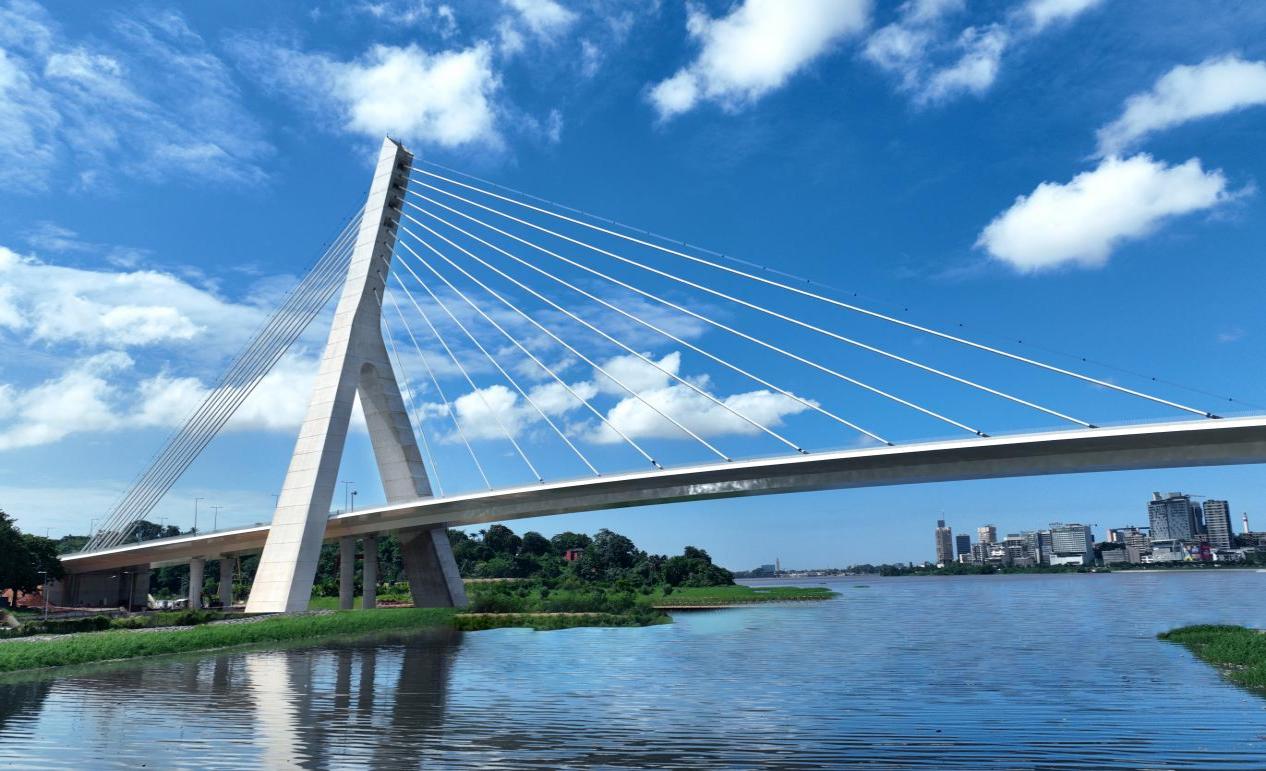
In Abidjan, the economic capital of Côte d 'Ivoire, the Koko Di Bridge – constructed by China Communications Construction Company (CCCC) – stands majestically over the azure waters of the Ebrié Lagoon. Its 108.6-meter-high' V-shaped 'main tower, painted in pristine white, defines the city's new skyline. Spanning 1.63 kilometers, this cable-stayed bridge not only dominates West Africa's infrastructure landscape but also serves as Abidjan's iconic 'city card,' showcasing groundbreaking technologies that set a benchmark for Sino-African infrastructure collaboration.
The core technology of this bridge—the "Key Technology for Constructing a Human-shaped Irregular White Concrete Cable Tower Composite Beam Cable-Stayed Bridge Based on Legal Standards" —has been evaluated by authoritative institutions and has reached the international advanced level overall, with some technologies even ranking among the world's leading. It successfully won the Second Prize for Scientific and Technological Progress of the China Highway Construction Industry Association in 2024. The most notable achievement is the breakthrough in a series of challenges in the application of white concrete in large bridges: the project team pioneered a whitening enhancement technology, developing high-strength white concrete with a whiteness exceeding 85 and a strength reaching C60 through in-depth research on the mechanism of ultra-fine calcium carbonate powder. At the same time, they innovatively adopted a self-cleaning method combining photocatalysis and superhydrophobic materials, effectively addressing the industry pain point of maintaining a clean appearance of white bridge bodies over the long term.
Facing the unique challenges of West African lagoons with extreme heat, humidity, and complex geological conditions, the technical team from China Communications Construction Company's Road Construction Division implemented precision strategies to overcome each technical hurdle. To meet regulatory standards, they independently developed structural calculation software, successfully resolving core design bottlenecks. By leveraging BIM modeling technology, they achieved seamless color control in irregular cable tower construction joints, ensuring the bridge's aesthetic integrity. To address the challenge of maintaining bridge alignment in high-temperature environments, they pioneered a large-section push-joint technique for steel trough beams, significantly enhancing construction accuracy and efficiency. The team has now established a robust intellectual property portfolio comprising 9 invention patents and 8 utility model patents, and even spearheaded the creation of the world's first "Technical Code for White Concrete Application", filling a critical gap in the industry.
Since its opening in August 2023, the Kokodi Bridge has seen an average daily traffic volume of 35,000 to 45,000 vehicles, reducing the travel time from Praud to Kokodi in Abidjan City from 1 hour to 5 minutes, completely alleviating cross-lake congestion. The "China master training African apprentices" model has cultivated local talents, enabling Chinese technology to take root in Africa.
Côte d 'Ivoire President Macky Sall praised the Côte d' Ivoire Bridge as "the culmination of aesthetics and architecture." At the opening ceremony of the 34th Africa Cup, the display of the bridge model further highlighted its significance as a landmark of African infrastructure. From the independent research and development of core technologies to the export of industry standards, this white bridge is not only a physical link between cities but also injects lasting momentum into the upgrading of African infrastructure through a "problem-oriented + standard-led" cooperation model, becoming another classic example of China-Africa joint construction of the Belt and Road and deepening practical cooperation. (Wang Bangmin)


Voice Of Zimbabwe: Your Source for Tech, AI, Aerospace, Biotech News
© Voice Of Zimbabwe Privacy Policy Contact us
