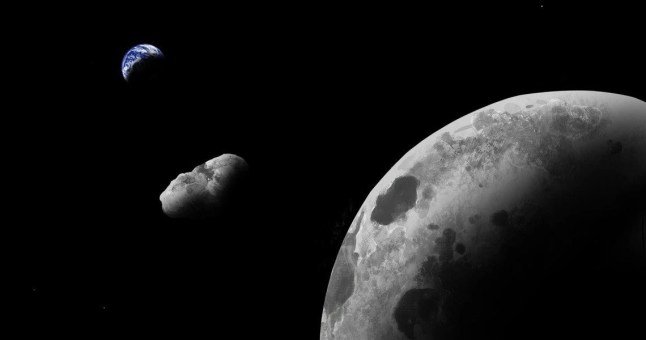
An artist’s impression of 469219 Kamo’oalewa (Picture: Sharkey et al./Nature Communications/University of Arizona)
Earth’s second moon is ready for its close-up.
China has shared the first-ever photograph of 469219 Kamo’oalewa,Hawaiian for ‘wobbling celestial object’.
Known to scientists as 2016HO3,the unusual near-Earth asteroid loops around the blue marble but is actually gravitationally bound to the sun.
Experts suspect this space rock is a piece of the lunar surface torn off by a meteor impact,so it could be a time capsule for the early solar system.
Which is exactly why China’s space agency sent the robotic Tianwen-2 spacecraft to collect samples of it last year.
Now,after travelling around 600million miles for 400 days,the space bot has sent back a historic photo of the rock.
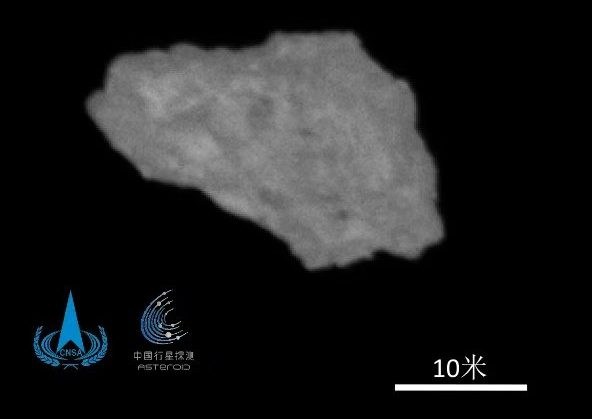
The first-ever image taken of Kamo’oalewa. ‘米’ in the bottom left corner is the Chinese word for metre (Picture: The China National Space Administration)
The image was taken just 20km from the asteroid,the Chinese National Space Administration (CNSA) said yesterday.
Kamoʻoalewa is estimated to be about 100 metres in diameter,which,if proven,would make it the smallest asteroid a spacecraft has ever said hello to.
Since the object only skirts by Earth every 45 years,it’s not officially a moon in the natural satellite sense.
Instead,it’s one of just seven ‘quasi-moons’ our planet has and is a type of asteroid called Apollo,which more or less snuggles up to Earth’s orbit.
From what we’ve seen so far,its orbital waltz with Earth began about a century ago,and will continue for a few more centuries.
Taking a cosmic photo isn’t as simple as point and shoot – officials had to use optical navigation data to check the asteroid’s position beforehand.
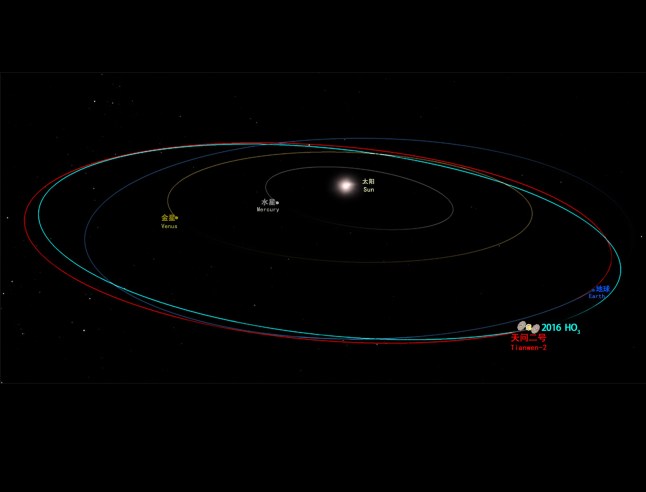
The space rock loops around the sun,not the Earth (Picture: Lunar and Deep Space Exploration Science Application Center)
This is vital because the eccentric rock is so tiny and often hides in the shadows of our planet; it’s hard to keep track of.
The rock’s trajectory,called ephemeris,shows that it’s tailing just behind the Earth’s clockwise orbit,according to a report published on China’s Lunar and Planetary Data Release System.
Asteroids,sometimes called minor planets,are made up of the remnants of the early days of the solar system.
These rocks can be as small as a frying pan or as wide as 329 miles but if all were squished together,they’d have less mass than the moon.
In Kamo’oalewa’s case,scientists discovered in 2021 that it seems to be made of the same frozen minerals found on the lunar surface.
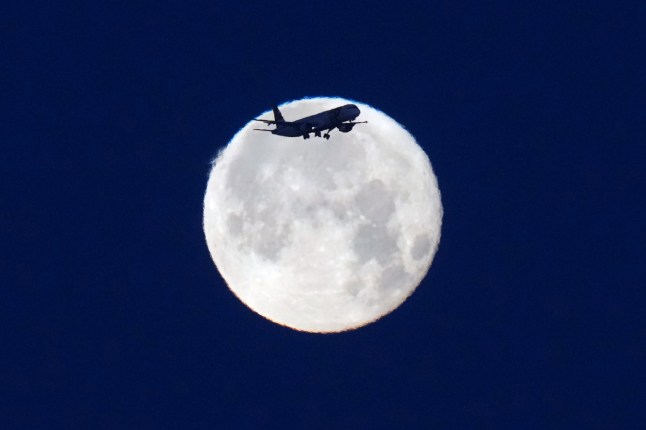
Scientists think the space rock is an old chunk of the moon (Picture: AP Photo/Armando Franca)
In other words,there’s a good chance it’s a stray chunk of the moon that’s decided to tag along with us; three other quasi-moons have a similar composition,so they could have come from the same cataclysmic lunar strike.
Others suggest it’s an asteroid caught in Earth’s gravitational dance,or the fragment of a rock torn apart by the Earth-Moon system.
Where this asteroid came from is one of the main questions China’s mission wants to answer.
Tianwen-2 lifted off aboard a Long March 3B rocket from the Xichang Satellite Launch Center in southwest China in May,state media said.
The next step will be for the robot to scoop up some celestial matter into a capsule before crash-landing into Earth late next year.
The CNSA added yesterday: ‘Going forward,the probe will gradually conduct more detailed scientific explorations to obtain information on the asteroid’s shape,material composition and internal structure,providing support for preparations for sampling.’
If China pulls this off,it’ll become the first country in the world – after Japan and the US – to retrieve material from a flying asteroid.
Get in touch with our news team by emailing us at .
For more stories like this,check our news page.


Voice Of Zimbabwe: Your Source for Tech, AI, Aerospace, Biotech News
© Voice Of Zimbabwe Privacy Policy Contact us
